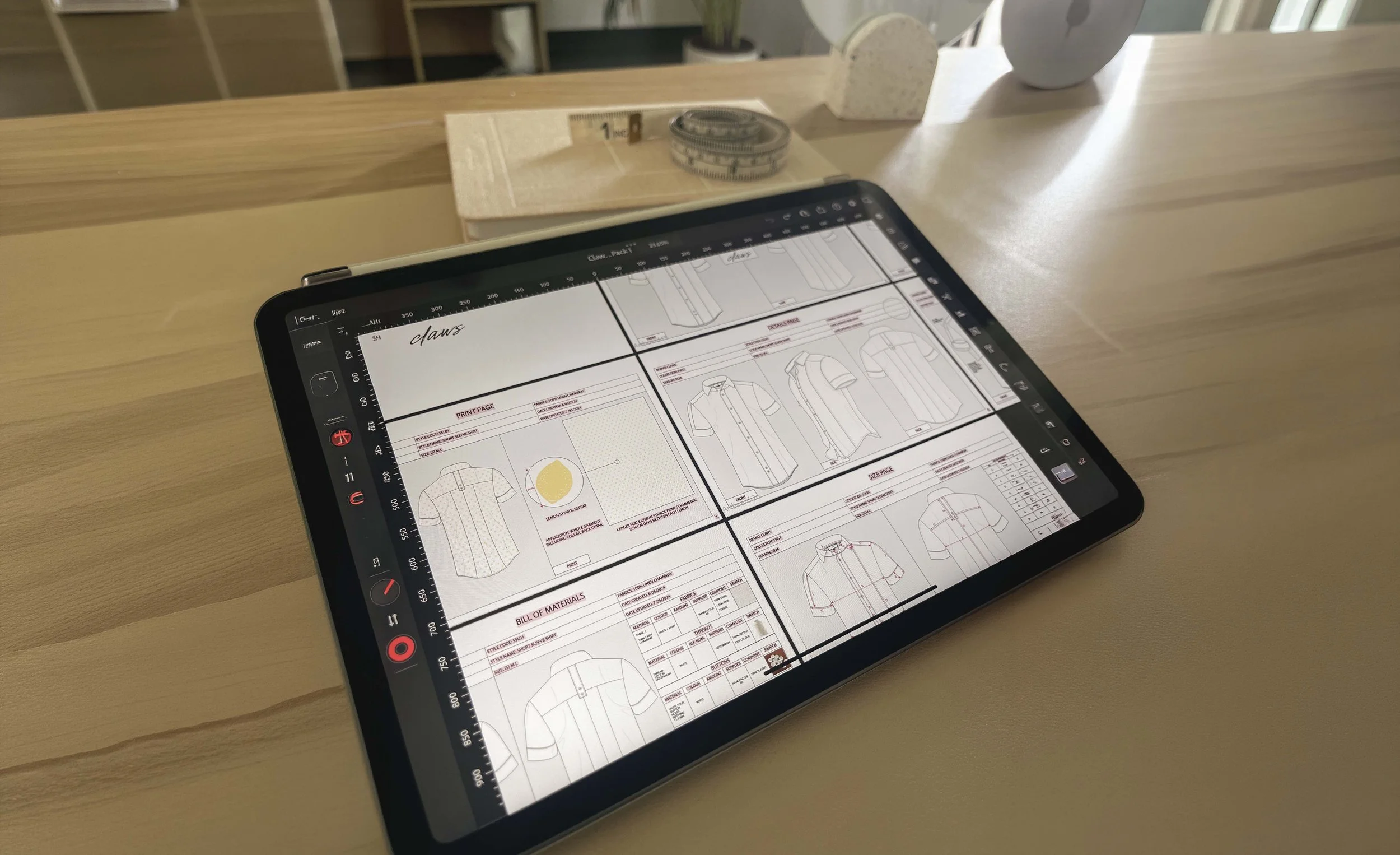
Every page a factory needs, what belongs on it, and a real example of each.
If you've searched what is a tech pack or tech pack template, you've found a definition and a downloadable form. The definition is usually right. The form is usually the problem, because a template tells you which boxes exist and nothing about what belongs in them.
A tech pack isn't a document you fill in. It's a set of decisions you've already made, written down in the order a factory needs them.
This is the structure I use for client packs, page by page, with a real worked example at the end so you can see what a properly specified garment actually looks like. If you're earlier than this and still working out category and quantities, start with how to launch your first fashion collection and come back.
What a Tech Pack Actually Is
It's the only document your factory works from.
Not your moodboard, not your emails, not the call you had last Tuesday. When a pattern cutter in Portugal or a sample room in Guangzhou opens your file, everything they need has to be in it, because they will not stop and ask about the things they don't realise are ambiguous. They'll make a decision, it will be a reasonable one, and it may not be yours.
That's the whole function. The pack removes interpretation.
It's also what gets you quoted accurately. A factory can't cost a garment from a sketch, because cost lives in the construction and the trims, not the silhouette. Vague pack, padded quote.
Tech Pack vs Spec Sheet: What's the Difference?
A spec sheet is the measurement table - points of measure, sizes, tolerances. One page.
A tech pack is the whole document, with the spec sheet as one page of it. People use the terms interchangeably and then discover mid-production that they sent a factory a quarter of what it needed.
Do You Actually Need One?
If you're producing more than a handful of units, yes.
A sample room can work from a sketch and a reference garment. Plenty do. But then the sample that comes back is their interpretation, you have no written spec to compare it against, and no grounds to reject anything. You'll pay for a second round to fix things you never specified.
The exception is a true one-off or a made-to-measure piece where you're in the room. Everything else, including a 30-piece first run, needs one. Small batch production doesn't mean lower documentation standards - if anything it means higher, because you can't absorb a wasted run.
The Pages, In Order
1. Cover Page
Style name and number, season, brand, date, version number, your contact details.
The version number matters more than it sounds. Packs get revised, factories keep whichever file they downloaded first, and a good share of production errors trace back to someone working from version 2 while you were discussing version 4. Date and number every revision, and say in the email which one supersedes which.
2. Flat Sketches
Front and back, line art, proportionally accurate, with every seam, stitch line, closure and opening visible.
Line art - not a render, not a shaded illustration, not a photo of something similar. A render hides construction behind shading, and generated ones frequently contain seams that can't physically exist. If you need to show detail, add callout views: a zoomed panel for a cuff, a pocket bag, a collar stand.
This is the page a factory looks at first and the one most often done badly.
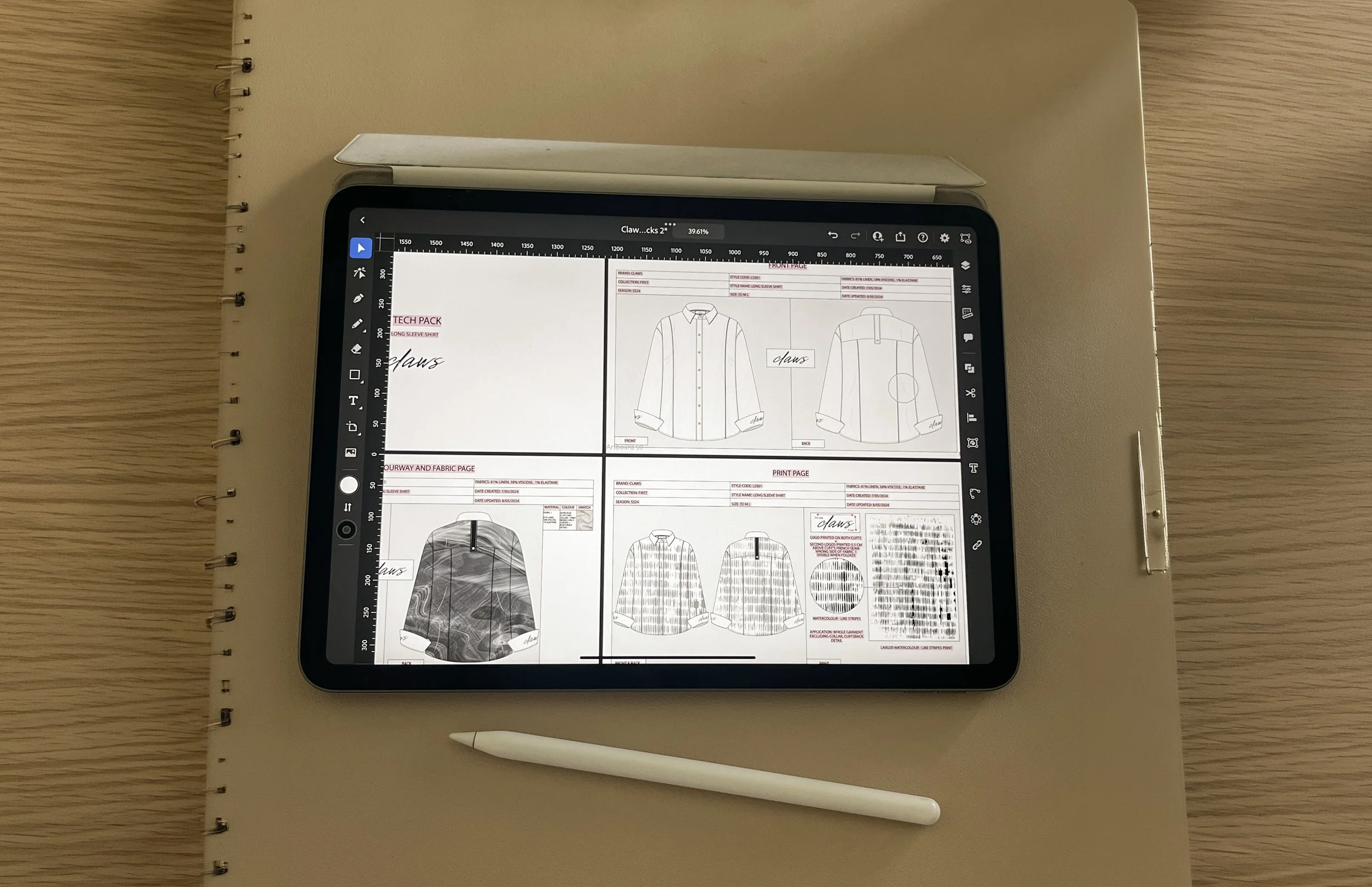
Front and back flats, colourway and print pages from a long sleeve shirt tech pack.
3. Bill of Materials
Every fabric that goes into the garment. For each: mill or supplier, article number, composition, weight, width, colour reference, consumption per garment, and minimum order quantity.
"Recycled polyester jersey, 220gsm" is a description, not a specification. A specification is a mill, an article number, a colour code and an MOQ. If you're still choosing fibres, From Cotton to Cactus covers the trade-offs.
Keep labels off this page. They get their own, because label content is a legal question rather than a sourcing one and it changes by market.
4. Trims and Hardware
Zips, buttons, drawcords, elastic, eyelets, interlining, thread.
Each needs brand, type, size or length, colour code, and for zips the puller style and whether the tape colour matches. "Invisible zip" is the kind of entry that produces three emails and a wrong sample. YKK 4CC, 20cm, colour 580, standard puller - that produces a sample.
Thread is the one people forget. Specify colour, and whether topstitch thread differs from construction thread.
5. Construction Callouts
How it's assembled. Seam type and stitch class for every join, stitch density, seam allowances, finishing at every raw edge, where it's topstitched and at what distance.
Call out stitch classes explicitly rather than leaving construction to the factory's default. A flatlock, a coverstitch and an overlock are different machines, different looks and different costs, and a factory that doesn't own the one you specified will quietly substitute.
If the terminology is new, Fashion Terminology Explained has the vocabulary.
6. Points of Measure
The measurement table: every point, the method used to measure it, the value in your base size, and a tolerance.
Two things get skipped here and both are expensive.
The first is method. "Chest 52cm" means nothing until you say where you measured - 2.5cm below the armhole, laid flat, across. Factories measure differently and will hit your number by measuring somewhere else.
The second is tolerance. Every point needs a plus/minus range. Without one you have no basis to reject a bulk delivery, and no factory will accept a claim against a spec that never set a limit.
These numbers must come from a real pattern or an approved fit sample. Measurements that look plausible but came from an average are the most expensive failure in the process, because they only surface at first sample.
7. Grading
How each measurement changes across your size range.
Grade rules are specific to the garment, the market and the customer. Software defaults give you a size 16 that fits nobody and a size 6 with sleeves for a much larger arm. Specify your increments per point of measure, and state your base size clearly - everything grades from it.
8. Labels
Brand label, care label, size label, content label. For each: type, dimensions, placement with a measurement, and attachment method.
Care and fibre content are legally required and the requirements differ by market, so this page changes depending on where you're selling. Get the wording right before you order - label minimums are high and reprints aren't cheap.
9. Packaging
Polybag specification, hangtag, any tissue, box or garment bag, folding instruction, and how the item sits in the carton.
Factories have a default way of folding and bagging. If you care how it arrives, specify it. Garment Packaging and Branding 101 covers the options and the lead times, which are longer than most people plan for.
10. Colourways
Every colour the style is produced in, with the fabric and trim references for each.
Not just "also in navy" - navy changes the thread, possibly the zip tape, possibly the label. Each colourway is effectively a variant of the bill of materials.
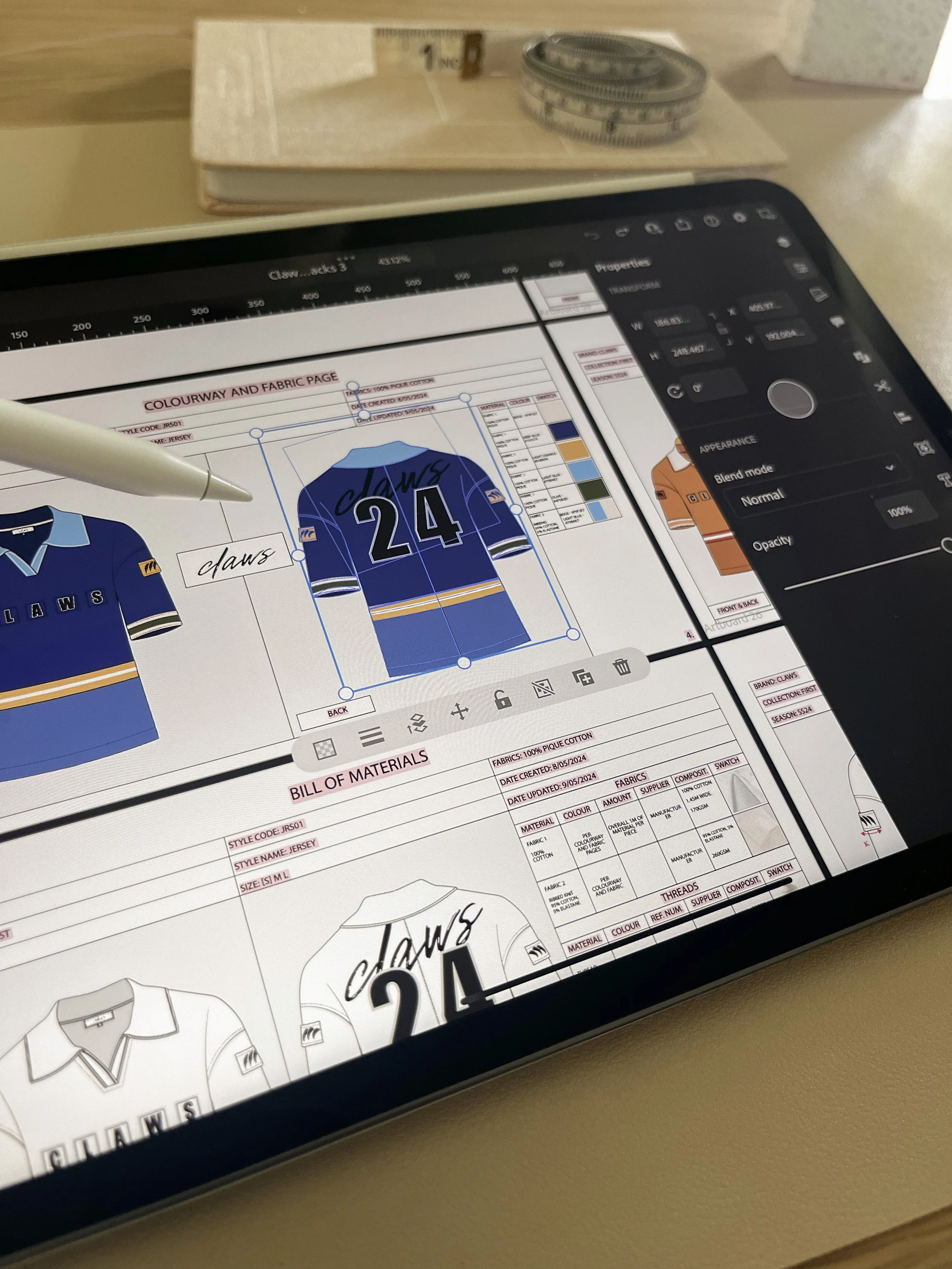
Colourway and fabric page from a jersey tech pack, with swatch references and the bill of materials below.
11. Compliance and Market Notes
Anything the factory needs to know about where the garment is going: required certifications, restricted substances, testing you need evidence of.
If you're selling into the EU there are registration obligations that apply regardless of volume, with no minimum exemption - what EPR actually costs small fashion brands explains what you'd need to register for and where.
What This Looks Like in Practice
Descriptions of pages only get you so far. Here's one style specified properly - a women's linen camp-collar shirt.
Bill of materials
Main fabric: mill name, article 4412, 100% European linen, 165gsm, 145cm usable width, colour Ecru, 2.1m per garment at base size, MOQ 300m per colour.
Interlining: supplier name, article G320, fusible non-woven, 40gsm, white, collar and stand only.
Trims
Buttons: corozo, four-hole, 18L, colour natural, 7 on centre front placket, 1 spare attached at inside hem.
Thread: Coats Epic 120, colour match to shell, used throughout. No contrast topstitch.
Points of measure, base size M
Chest, measured 2.5cm below armhole, laid flat, across: 54.0cm, tolerance ±1.0cm.
Back length, from high point shoulder straight down to hem: 68.0cm, ±1.0cm.
Sleeve length, from shoulder point to hem of sleeve: 24.0cm, ±0.5cm.
Collar stand height at centre back: 3.2cm, ±0.2cm.
Grading, per size
Chest 4.0cm. Back length 1.5cm. Sleeve length 0.5cm. Collar stand does not grade.
Construction
Side seams and sleeve seams: French seam, 6mm finished.
Armhole: flat-felled, 8mm, topstitched at 6mm.
Hem: double-turned 10mm, single needle, stitch density 10 per inch.
Placket: 32mm finished width, interlined, topstitched 2mm from both edges.
Now compare that to what most first packs contain: "linen shirt, relaxed fit, natural buttons, chest approx 54cm." Both describe the same garment. Only one of them can be made twice and come out the same.
Notice too how much of that is numbers rather than adjectives. That's the test. If a line of your pack could be satisfied in two different ways by a reasonable person, it isn't specified yet.
What Happens When a Page Is Missing
Nothing, immediately. That's the trap.
The factory makes a reasonable decision, the sample comes back, and the fault looks like theirs. It usually isn't. I wrote up a real client case of exactly this in It Wasn't the Factory's Fault - three factories, three bad samples, one incomplete pack.
The costly version is the pack that's incomplete but looks finished. A visibly rough document gets questioned - someone emails before anything is cut. A polished, confidently worded, quietly wrong one gets made. That's also the reason to be careful with generated packs, which I covered in Can AI Write Your Tech Pack.
How Do I Make a Tech Pack Myself?
You can, and the order matters more than the software.
Work pattern first, then measurements, then everything else. Most of the packs I'm asked to fix were built the other way round - the document was designed before the garment was, and the numbers were reverse-engineered to fit it.
Practically: get a pattern made or buy a block and have it adapted. Make one sample from it. Measure that sample, point by point, writing down how you measured each one. Those numbers become your spec page. Everything else - BOM, trims, construction - you already decided while making the sample; the pack is just where you record it.
Tools are secondary. Illustrator, a spreadsheet and a PDF export will produce a pack a factory can work from. Dedicated software helps when you're running multiple styles and need version control, not before.
The part that takes experience is judgement: which seam, which tolerance, which grade rule. That's the part the document exists to carry, and it's the part no template supplies.
How Much Does a Tech Pack Cost?
For a single style, professionally produced, expect €300 to €600 depending on complexity. Mine are €390 per style.
That sounds like a lot until you price the alternative. One wasted sample round - fabric, labour, courier, and four to six weeks of calendar - costs more than the pack. A wrong bulk delivery costs considerably more than that. The full set of numbers is in what it costs to start a fashion brand.
A cheap pack that isn't grounded in a real pattern isn't a saving. It's a deferred cost with interest.
Common Questions
What is a tech pack in fashion?
The technical specification a factory manufactures from. It contains flat sketches, materials, trims, construction details, measurements with tolerances, grading, labels and packaging for one style.
Do I need a tech pack for a sample?
Yes, and especially for a sample. The sample is where you find out whether your specification produces the garment you intended. Without a pack you aren't testing anything, you're commissioning someone's interpretation.
How many pages should a tech pack be?
Six to fifteen for most garments. A simple tee sits at the low end, outerwear with multiple components at the high end. Length isn't the measure - completeness is.
What file format do factories want?
PDF, almost always, with the live file kept by you for revisions. Some factories running PLM systems will ask for a specific import format. Ask before you build.
Can I use a free tech pack template?
As a structure, yes. As a shortcut, no. A template gives you headings. What makes a pack work is the numbers underneath them, and those have to come from your pattern, your fabric and your factory.
Who writes the tech pack - me or the factory?
You. A factory that offers to write it is describing what it intends to make, not what you specified, and you'll have no independent document to hold it to.
Final Thoughts
The value in a tech pack was never the document. It's the decisions inside it - which seam, which fabric, which tolerance, and why each one.
That's why a template alone doesn't get you there. The boxes are the easy part. What fills them is a pattern that exists, a fabric you can actually buy, and a factory whose machines match what you've specified. Get those three right and the pack more or less writes itself. Get them wrong and the most beautifully formatted document in the world still produces the wrong garment.
Need a tech pack your factory can actually work from? I write and review production-ready packs for brands manufacturing across Europe, the US, Australia and Asia, and a review costs a fraction of a wasted sample round. Book a consulting session →